
Overlap tools answer one pair at a time, so the natural question is which pair tops the scale. In the ETFCompare dataset, 108 ETFs with a designated rival each (records dated September 15, 2026), it is MGK vs VUG: a 63.46 percent holdings overlap, the highest of any pair we record, with a one-year return correlation of 0.993. Both are Vanguard growth funds. MGK (Vanguard Mega Cap Growth) holds 59 mega-cap growth names; VUG (Vanguard Growth) holds 150 large-cap growth names. The smaller fund lives almost entirely inside the larger one, and this page, built the way overlap pages are built, shows what that does to returns, costs and the case for owning both.
The overlap, read properly
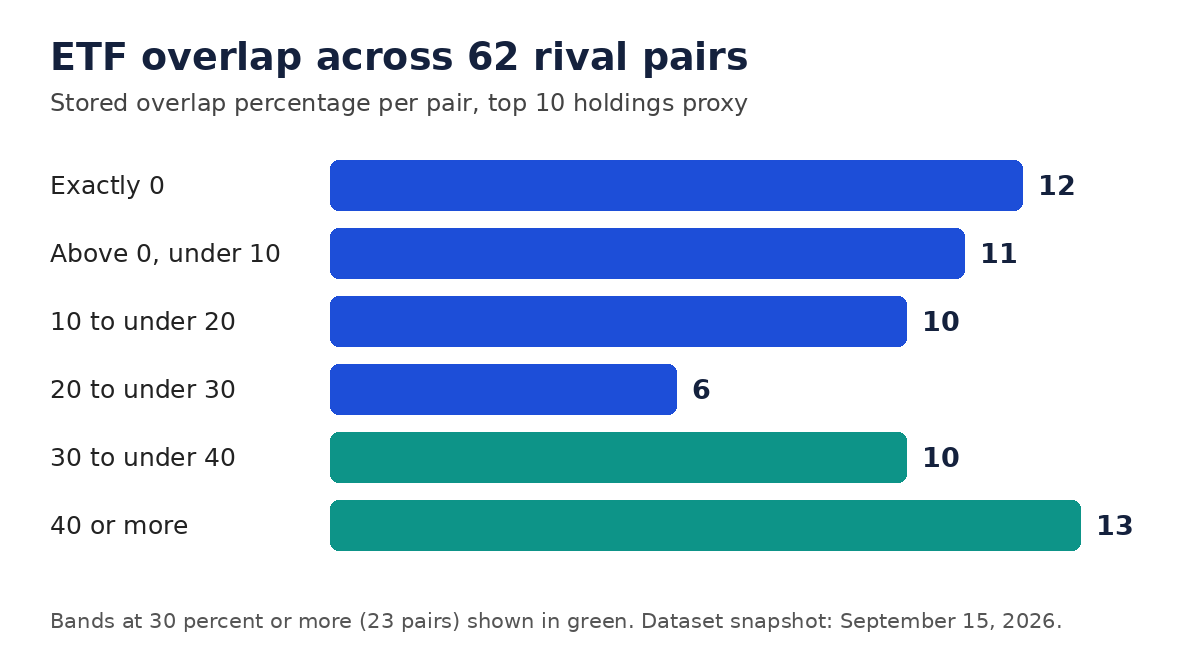
Overlap here is measured across the funds' recorded top holdings, the same basis the ETF Overlap X-Ray reports and the one used across this site. At 63.46 percent, nearly two thirds of what these funds hold at the top is the same companies in similar proportions. The shared summit is exact: both funds' largest holding is NVDA, at 13.52 percent of MGK and 12.80 percent of VUG. The census of all 62 unique rival pairs put the median overlap at 18.32 percent, so this pair is not a typical rivalry; it is the distribution's ceiling, counted in the overlap census.
What the extra third buys
The non-overlapping third is MGK's concentration. Its 59 names are the mega-cap end of VUG's 150, so the difference between the funds is the mid-tier growth names VUG holds and MGK skips. Recorded returns at the snapshot show what that bought: one year, MGK 13.85 percent against VUG 11.99; three years, 23.77 against 23.06; five years, 13.26 against 12.19; ten years, 18.64 against 17.65. MGK leads at every horizon, by margins between 0.7 and 1.9 points, the mega-cap tilt paying steadily rather than dramatically. The fee runs the other way, 0.05 percent for MGK against 0.03 for VUG, and the yield is a wash, 0.27 against 0.31 percent.
Owning both, honestly
A portfolio holding both funds is, to a 0.993 correlation, a portfolio holding VUG with a mega-cap overweight, at a blended fee above VUG's alone. That can be a deliberate construction, but it is rarely the one investors think they built, because the two names, two issuers' pages (both Vanguard, in this case) and two inception dates (2007 and 2004) read as variety. The screening habit that catches it is the one this site exists for: before adding a fund, check it against what you hold, the way the pair pages in this series do for QQQ vs VOO (31.75 percent on the same basis) and VOO vs VTI. If the overlap prints above 60, you are not adding a fund. You are resizing a position.